The Eagle's Choice
A story about Change
The Eagle’s Choice
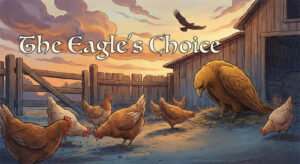
There was a chicken farmer who was a keen rock climber. One day, climbing a particularly challenging rock face, he came upon a large ledge. On the ledge was a nest, and in the nest, three large eggs. Eagle eggs.
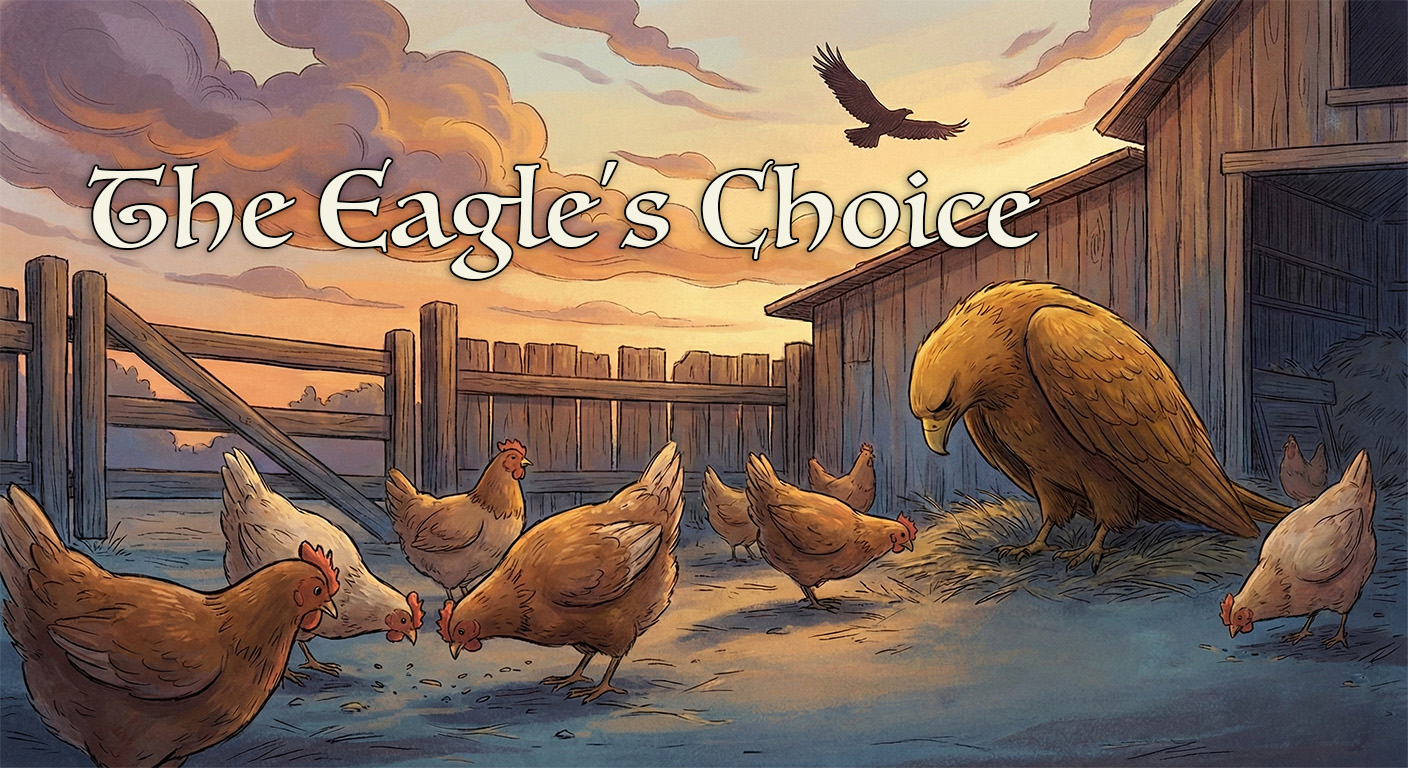
Temptation got the better of him. He took one egg, brought it home, and placed it in the henhouse. The mother hen sat on it proudly, and in time, a baby eagle emerged. “Mama!” it squawked, and so the eagle grew up among chickens.
But from the very beginning, something was wrong.
The eagle was too big. His beak was too sharp. His talons too curved. When he tried to scratch in the dirt like his siblings, he dug too deep. When he tried to roost on the low perch, his weight made it crack. His wings were too large, always knocking things over, always in the way.
“Why can’t you be more careful?” clucked his mother, exasperated after he’d accidentally knocked over the water dish again.
“What’s wrong with you?” sneered the rooster. “Why can’t you just be normal?”
The other chicks kept their distance. He didn’t fit in the tight spaces they loved. He couldn’t master their quick, efficient pecking. Everything that came naturally to them felt awkward and wrong in his body.
“Maybe if I just try harder,” he told himself. “Maybe if I make myself smaller, quieter, more careful…”
So he learned to tuck his wings tight against his body. He learned to move slowly, cautiously. He learned to apologize for taking up space. He learned that “different” meant “defective,” and he carried that shame like a stone in his chest.
Years passed this way—the eagle folding himself smaller and smaller, trying desperately to become something he wasn’t, believing that the problem was him.
Then one day, late in his life, something happened.
The eagle was in the barnyard, hunched as usual, when he happened to look up. High overhead, soaring majestically on the thermal currents, flying effortlessly with scarcely a beat of its powerful golden wings, was an eagle.
The sight struck him like lightning. He stood transfixed, something deep in his chest awakening—a recognition, a longing, a memory his body held that his mind had forgotten.
“What is that?” he whispered in awe.
An old hen nearby—one who had always been kinder than the others—looked up. She studied the bird in the sky. Then she looked at him. Really looked at him, perhaps for the first time.
“That’s an eagle,” she said softly. “The King of the Birds.”
She tilted her head, looking between him and the majestic creature above. “You know… you look more like that eagle than you look like us.”
The words hung in the air.
“You could learn to fly like that,” she continued, her voice gentle but certain. “I think… I think that’s what you were meant to do. I think that’s why nothing here ever fit you right—not because you were broken, but because this was never your home.”
For one electric moment, the eagle felt something shift inside him. Not broken. Not wrong. Just… an eagle among chickens.
He could learn. He could spread those wings he’d kept tucked so tight. He could discover what his body had been trying to tell him all along. He could become majestic, powerful, free—everything that creature in the sky embodied.
But then the fear came crashing in.
“Learn to fly?” His voice trembled. “But… I don’t know how. What if I fall? What if I get hurt?”
His mind raced with terrifying possibilities: “What if I get lost up there and can’t find my way back? What if there’s no food? What if I starve? What if there are storms, or predators I don’t know how to face? What if I’m alone?”
He looked around the barnyard—the dusty ground he knew intimately, every pebble, every corner. The feeding trough where food appeared reliably twice a day. The henhouse where, even if he didn’t quite fit, he at least knew where the dangers were.
“Here I know everything,” he said, his voice small. “I know where to find food. I know where to sleep. I know which roosters to avoid and when the farmer comes. Yes, they ridicule me. Yes, it hurts. Yes, I’ve never quite belonged…”
He looked up at the eagle again, still soaring, still magnificent.
“But at least I know how it hurts here. At least I know what to expect. Out there?” He gestured vaguely at the endless sky. “Out there, anything could happen. I could fail. I could die. At least here… I know how to survive.”
The old hen watched him with sad, knowing eyes. She didn’t argue. She simply said, “So you’ll choose the pain you know over the life you don’t?”
“It’s not really a choice,” the eagle said quietly. “It’s… practical. It’s safe.”
“Safe,” she repeated. “Is that what you call this? What you’ve been living?”
The eagle had no answer. He tucked his magnificent wings tighter against his body and went back to scratching in the dirt, trying not to notice how wrong it still felt, how his talons were made for gripping branches he’d never known, how his wings ached with a strength he’d never used.
Above him, the other eagle circled once more, then caught a thermal current and disappeared over the horizon—toward mountains the barnyard eagle would never see, toward a life he’d glimpsed but would never claim.
That night, he roosted in his usual spot, too large for the perch, uncomfortable as always. But at least it was familiar. At least he knew exactly how it would hurt.
And he told himself that was enough.
He told himself that was wisdom.
He told himself the devil you know is always better than the devil you don’t.
But deep in his chest, in a place he tried hard not to listen to, his heart whispered a different truth: that he wasn’t choosing safety—he was choosing a smaller cage. That “knowing how to survive” in the wrong life is not the same as living. That the sky wasn’t a devil at all.
It was just the sky.
And he was still an eagle.
The saddest distance in the world is not from earth to sky. It’s the distance between knowing what you could become and choosing to stay what you’ve always been—not because you can’t change, but because the familiar pain feels safer than the uncertain journey.
Here are more stories for you to enjoy: