True Light
A story about Cravings
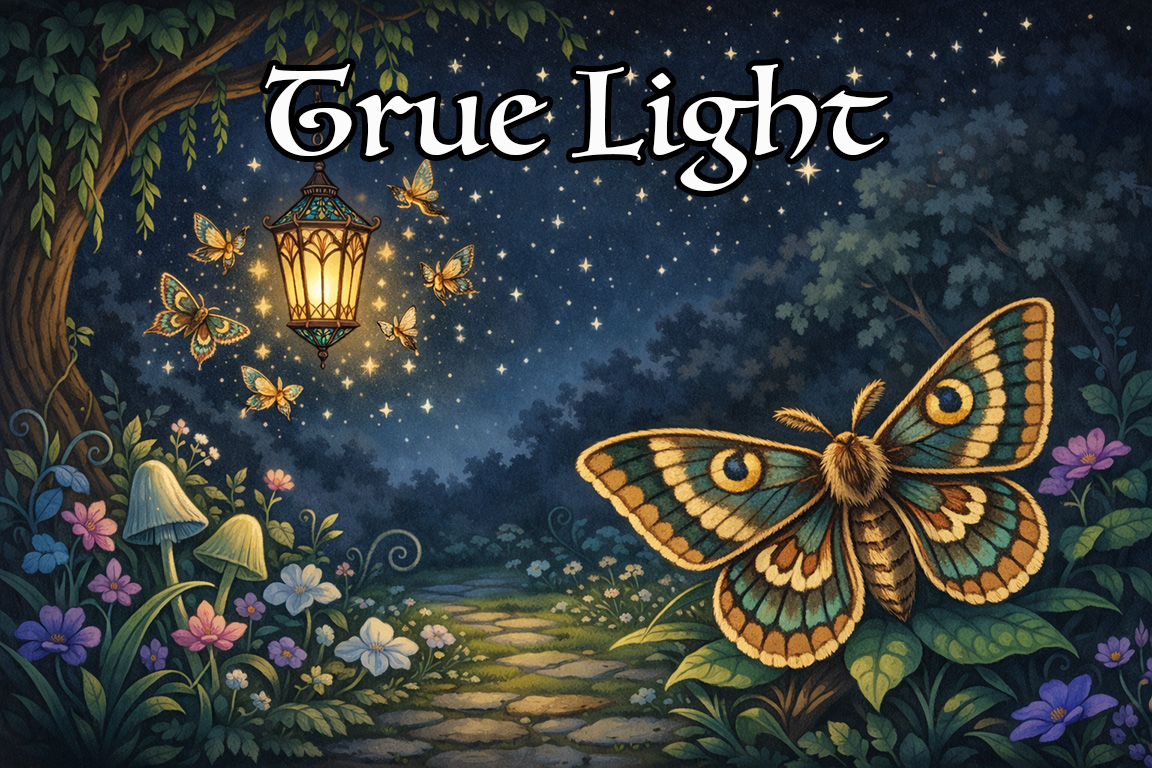
Mara was born at the end of summer, in the tall grass at the edge of a garden, and from her very first night she knew the light.
In those early weeks, the sun rose early and stayed long. Mara would feel the light and warmth on her wings and something in her would settle, completely and without effort, the way a held breath finally releases. This, her whole body seemed to know, is right. This is what we are made for.
She did not think of it as the sun. She had no name for it. She only knew the feeling — that deep, unhurried warmth — and she carried it inside her the way you carry something so familiar you forget you’re carrying it at all.
Then the days began to shorten.
It happened slowly at first, almost gently — the light retreating a few minutes each evening, the mornings arriving a little later, the warmth thinning at the edges. Mara barely noticed. And then one night she woke in the darkest hour, opened her wings, and the sky was simply — empty. Black from one end to the other. No pale promise at the horizon. No warmth. Nothing.
She flew in slow circles, confused. The feeling she had always known was gone, and she did not understand where it had gone or why, only that its absence left a hollow, aching space where something solid used to be. Around her, other moths were doing the same — circling in the cold dark, wings open, searching. Some flew until they could fly no more, then dropped back into the grass, exhausted not by effort but by despair. They had lost something and they did not have words for what it was.
Night after night it was the same. They would wake. They would search. They would find nothing and return to the grass, spent and hollow.
Until one night, a light appeared at the garden gate.
. Mara felt its warmth from twenty wing-beats away, and something in her chest lurched with recognition. That feeling. That was the feeling. Not quite — not entirely — but close enough that every part of her moved toward it before she had made any decision at all.
She was not the only one. The other moths came too, drawn by the same hunger. Within moments they were all circling the light — looping through its glow, returning, looping again — as though if they could only get close enough, stay long enough, the real thing might come back.
She did not think of it as a lantern. She did not think of this as fire. She only thought, or rather felt, in the wordless way of moths: this is very much like what I lost. And perhaps this will be enough.
Each pass brought a faint sting at the tips of her wings. She barely noticed. The relief was so close to the real thing — close enough, in the dark, in the cold, in the absence of any other option — that the sting seemed a small price. Around and around she went until exhaustion pulled her back to the grass, and she slept, and when she woke the dark was waiting, and the lantern was there, and she went back.
This became her life. She stopped remembering, after a while, that she was looking for something. She only knew the cycle: the ache, the light, the relief that never quite lasted, the ache again.
One night, an old owl named Ezra settled on a stone beside her while she rested between loops. Owls see the whole night through — every hour of it, from first dark to first light — and Ezra had watched this garden across many winters. He knew what the moths were looking for. He also knew they would not find it in the lantern.
He did not say this. He only said: “I wondered if I might sit with you for a while.”
Mara looked at him, then back at the lantern. Something about the stillness of him made her stay.
“Does it help?” he asked, after a long quiet.
“It feels like it should,” she said, and this was the most honest thing she had said in a long time. “There’s something in it that I remember. Something that used to feel — whole. But when I go back to the grass, the ache is still there. Sometimes deeper.”
Ezra was quiet for a moment. “What you remember is real,” he said. “I want you to know that. You are not imagining it, and you are not wrong to want it back.”
Mara looked at him. Nobody had said this to her before.
“The others all come here too,” she said. “We all felt the same loss. I thought — if we all arrive at the same place, surely this must be what we’re looking for.”
“You are all looking for the same thing,” said Ezra gently. “But the lantern is not it. It only resembles it — enough to feel familiar in the dark, enough to quiet the ache for a little while. That is not nothing. But it is not the thing itself.” He turned his great eyes toward the horizon. “Wait,” he said. “Just a little longer.”
It was hard. The ache was present. The lantern blazed, and the other moths circled, and everything in Mara pulled toward it. But she stayed on the stone, and Ezra stayed beside her — not explaining, not promising, simply remaining. As though sitting with her in the dark was enough. As though she was worth the waiting too.
The darkness shifted almost without announcing itself. Black softened to deep blue. Then the blue grew pale at the very edge of the garden, and then — slowly, enormously, without any hurry at all — the light came.
It was not like the lantern. The lantern had been sharp and immediate, a point of brightness in the dark. This was different. This spread. This grew. This reached her not just at the surface of her wings but somewhere underneath, in the hollow place — and the hollow place, for the first time in months, began to fill.
Mara went very still.
She looked back at the lantern. In the morning light it was already fading — a pale, yellowish flicker, small and man-made, doing its modest best. She did not hate it. It had been the only warmth available in the dark, and she understood now why she had gone to it, and why all the others had too. But it was not what she had lost. It was only the shape of what she had lost, lit up in the dark.
“It will be dark again tonight,” said Mara quietly.
“It will,” said Ezra. “And the ache may come with it. But now you know what you are waiting for. That is enough to wait with, no?!”
Her wings were ragged at the edges. The cold had not yet left the air. But she sat in the growing light and felt it reach the places the lantern never had, and for the first time since summer, she was not afraid of the dark that would come tonight. She remembered now what lived on the other side of it.
Here are more stories for you to enjoy: