The Lantern Keeper

The Lantern Keeper

I have created this stroy for a client who had difficulty to deal with the feeling of loss and emptiness after his partner passed away. upon hearing the story, and once the tears dried they were able to go on carrying the memory life “flike firewood — something that warms you. Not like stones in your pockets, dragging you into the sea”. I hope other might find solace in this story as well.

There was once a village stitched to the edge of the world.

It wasn’t on any map, unless you counted the ones drawn in dreams or in the margins of forgotten books. A crooked little place where the houses leaned into the wind and the sea always whispered secrets, though most people had learned not to listen.

At the far end of the village, just where the earth began to wonder if it ought to become sea instead, there lived the Lantern Keeper.

They were not old, not really. But their eyes had seen things that made time wrap itself around them like ivy. Their job — the kind passed down in silence, like a burden or a birthright — was to light the lanterns along the shoreline each night, so that lost things could find their way home.

The Lantern Keeper wasn’t alone, not once. There had been another — someone who wore laughter like a scarf and always knew when the wind would turn. They moved through the world together like ink and paper — one making sense of the other.

They shared everything: a crooked house with uneven floors, the secrets of flame, and the quiet language that exists only between people who have chosen each other again and again.

But then came the storm.

It wasn’t the kind that rattled windows or tore up boats. It was worse — quiet and invisible. The kind that slips in when you’re looking the other way. And when it passed, the world remained mostly as it had been — the sea still sighed, the stars still blinked — but the other was gone.

Just… gone.

And the Lantern Keeper, now alone, did what people do when the world stops making sense: they kept doing what they knew. They lit the lanterns. They walked the wind-carved path. They waited.

Nights passed. And then weeks. And then that strange, rubbery sort of time that follows grief, where days lose their names and everything tastes like ash.

One evening, as twilight curled itself around the sky like a cat, a stranger came to the village. The sort of stranger who doesn’t knock, who seems to know the way without being told. His boots were muddy and his coat smelled of old rain, and he carried a satchel full of silence.

He sat beside the Lantern Keeper on the hill, where the biggest lantern stood — the one that burned brighter than memory and almost as fierce as love. He didn’t say hello. People like him rarely do.

They sat together in silence for a long time — the kind of silence that isn’t empty, but thick, like the pause in a story before something important happens.

Then, without turning his head, the stranger spoke:
“You’re wrong, you know?!”

The Lantern keeper turned his head, if he was able to raise one eyebrow he would have.

“You think they’re gone.”

The Lantern Keeper didn’t answer. Not because it wasn’t true, but because it was too true to hold gently.

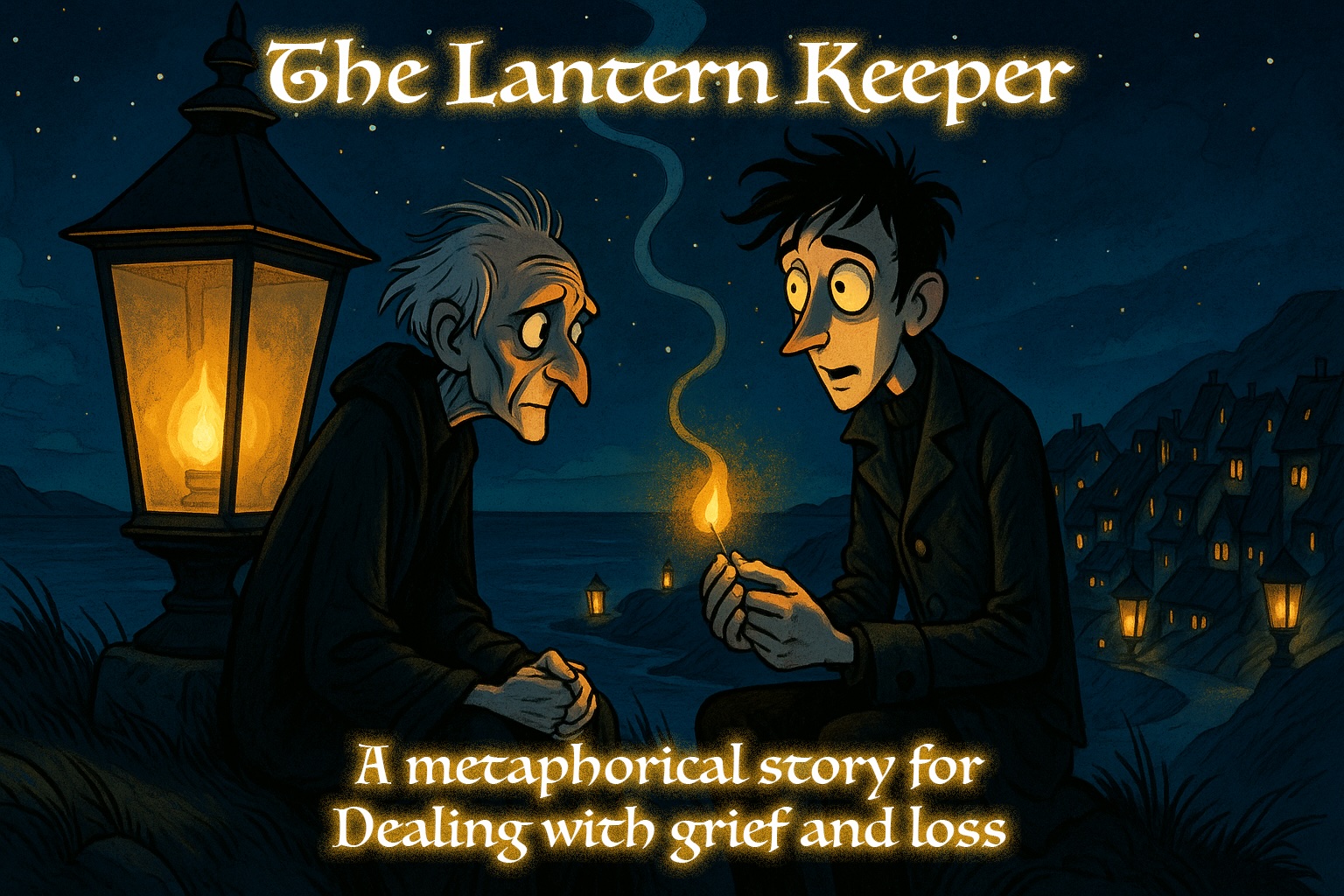
The stranger reached into his coat and pulled out a match — an old one, made of bone or driftwood or something that remembered being alive. He struck it, and the flame danced a peculiar shade of gold.

“They’re not gone. Just elsewhere.”

The Keeper frowned. “Elsewhere?”

“Yes.” The stranger cupped the flame with both hands. “There are places people go when stories end. And other places they go when stories change. Your person… they’ve simply walked into a different part of the tale. One you can’t see from this page.”

The flame flickered, casting long shadows across the lantern’s glass. The Keeper’s voice was barely more than breath. “But I can’t follow. I can’t talk to them. I don’t even know if they still… exist.”The stranger gave a small hum — somewhere between a laugh and a sigh.“They exist in you. That’s where they planted the last part of themselves — in the spaces you now ache.” He glanced sideways. “That pain you feel? It’s not proof they’re gone. It’s proof they were real.”

The Keeper closed their eyes.

“I don’t want to forget.”

The stranger nodded.
“Then don’t. Forgetting isn’t the point. Carry them. But carry them like firewood — something that warms you. Not like stones in your pockets, dragging you into the sea.”

A pause. The wind softened.

“Grief,” the stranger whispered, “is just love that doesn’t know where to go. So it waits. It builds lanterns. It plants gardens. It writes songs in the wind. And that’s alright. Let it stay a while. Just don’t forget to live beside it.”

The match burned out, and the smoke curled upward like a final word.

The stranger stood.

“Light the lanterns. Tell the stories. That’s how you keep the door open.”

“To what?” the Keeper asked.

The stranger smiled, eyes crinkling like old paper.
“To the part of the story they’re still in.”

And with that, he was gone. Whether he walked into the mist or was never really there at all, the Keeper never knew. But the words — those stayed.

People say if you go to that village now — not the one on the map, the other one — you might see a figure walking the shoreline, lantern in hand, humming the ghost of a song. And sometimes, just sometimes, you might catch another figure walking beside them — made of light and salt and memory, smiling in a way that only the dead who are still loved know how to smile.

They say the Keeper never stopped grieving.

They just learned how to make it beautiful.
Tom and the Mysterious Egg

Tom and the Mysterious Egg

A story written to work with people who are feeling jealous and envious of others. I wanted to avoid using the words jealousy so the mind will not resent the story immediately.

Once upon a time, in a village brimming with enchantment, lived a man named Tom. Tom was renowned for nurturing the most extraordinary creatures, each one a marvel of magic and wonder. There was Shimmer, a butterfly whose wings changed colors with the seasons, and Whistle, a tiny dragon who could heal wounded hearts with his gentle songs. Then there was Luna, a silver fox who could weave moonbeams into blankets of comfort, and Pip, a cheerful sprite who made flowers bloom with laughter.

The villagers adored Tom’s creatures, gathering in his garden each evening to watch them perform their gentle magic. Children would clap as Whistle sang away their scraped knees, and elders found peace watching Luna weave her moonbeam tapestries. Tom took immense joy in caring for them, spending his mornings feeding them nectar and starlight, and his evenings brushing their fur and scales while they shared the stories of their day.

One day, Tom heard whispers of a grand competition where the finest magical creatures would be celebrated. Village criers spoke of judges from distant kingdoms and prizes that would bring honor to the winners. With excitement in his heart, he decided to enter the competition and proudly presented his beloved creatures.

The day of the competition was magnificent. Tom watched with pride as Shimmer danced through the air, her wings painting rainbows across the sky. Whistle sang a melody so pure that several judges wiped away tears, and Luna’s moonbeam display left the crowd gasping in wonder. When the results were announced, Tom was awarded second place. Though he was content and his creatures nuzzled him with affection, a spark of determination was lit within him to achieve even greater heights next year.

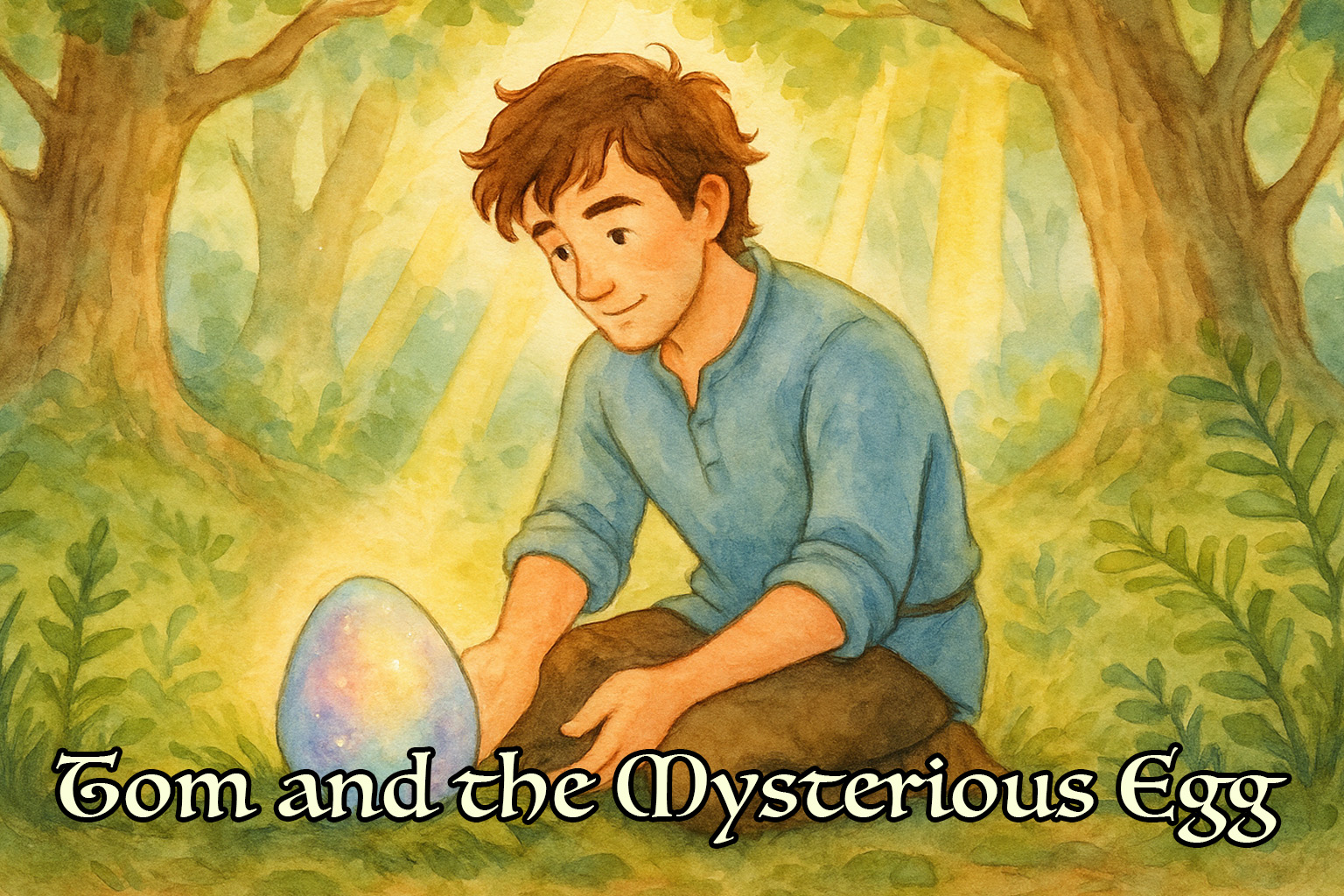
As he prepared for the next competition, Tom spent long hours in the forest searching for inspiration. It was during one of these wanderings that he stumbled upon a mysterious, shimmering egg hidden deep within a grove of ancient oaks. The egg pulsed with an otherworldly light and seemed to whisper promises of greatness. Convinced that this egg would hatch the creature that would help him win first place, he took it home and nurtured it with great care.

Tom placed the egg in a special nest lined with silk from grateful spiders and warmed by captured sunbeams. He sang to it each morning and read stories of legendary creatures each evening. His other beloved animals watched curiously as Tom devoted more and more time to the mysterious egg.

When the egg finally hatched, out came a small, enchanting creature unlike anything Tom had ever seen. It had the sleek body of a cat, wings like a bat, and eyes that seemed to hold swirling galaxies. The creature filled Tom with an intoxicating sense of ambition and drive. It whispered to him about winning, about being the best, about showing everyone that his creatures were superior to all others.

But as time went on, the creature grew larger at an astounding pace, transforming before Tom’s very eyes. Tom became entranced by its rapid growth and the intoxicating promise of victory it whispered to him each day. Day by day, he found himself spending more and more time with the mysterious creature, feeding it the finest delicacies and devoting his energy to its care. Without realizing it, Tom began to neglect his other beloved companions. 

Shimmer’s wings grew duller, Whistle’s songs became hesitant, and Luna’s moonbeams flickered uncertainly. Pip stopped making flowers bloom, curling up in a corner with worried eyes. The creature from the egg, now as large as a wolf, fed on Tom’s growing dissatisfaction, its galaxy eyes spinning faster with each doubt that consumed him.

One evening, as Tom sat surrounded by his fading creatures, he caught sight of his reflection in Luna’s dimming moonbeam pool. The man looking back at him was hollow-eyed and restless, his hands clenched with tension. Behind him loomed the creature from the egg, its presence casting shadows over everything he had once cherished.

It was then that Tom realized that his pursuit of winning had clouded the true magic he always had. The creature hadn’t brought him closer to victory—it had stolen the very thing that made his other creatures magical: his unconditional love and joy in their simple existence.

In a moment of clarity, Tom turned to the creature from the egg. “You must go,” he said softly but firmly. “This is not the magic I want in my life.”

The creature hissed and its galaxy eyes swirled angrily, but Tom’s love for his true companions gave him strength. As he spoke words of release, the creature began to shrink, its form becoming transparent until it dissolved like morning mist.

Immediately, Tom felt the weight lift from his heart. He gathered his creatures close—Shimmer, Whistle, Luna, and little Pip—apologizing for the distance he had allowed to grow between them. As he held them, their magic began to return. Shimmer’s wings burst with more vibrant colors than ever before, Whistle sang a melody of forgiveness so beautiful it made the stars dance, Luna wove moonbeams of pure silver joy, and Pip laughed as flowers bloomed all around them.

In doing so, Tom found that his happiness and fulfillment were never about winning, but about cherishing the magic he had all along. When the next competition came, he entered not to win, but to share the wonder of his creatures with the world. And though he didn’t take first place, the love radiating from him and his creatures touched every heart in the audience, creating a magic more powerful than any prize could ever be.

Percy, the Purple Turtle 

The Story of Percy, the Purple Turtle 

This story was written to help people who suffer from fear of rejection, low self esteem or low self image. I have found this story to help them realize the damagae they inflict on themselves by shutting themselves off, instead of sharing their magic with those who want to enjoy it. I hope others can find solace with this story, and if you do, I would love to know!

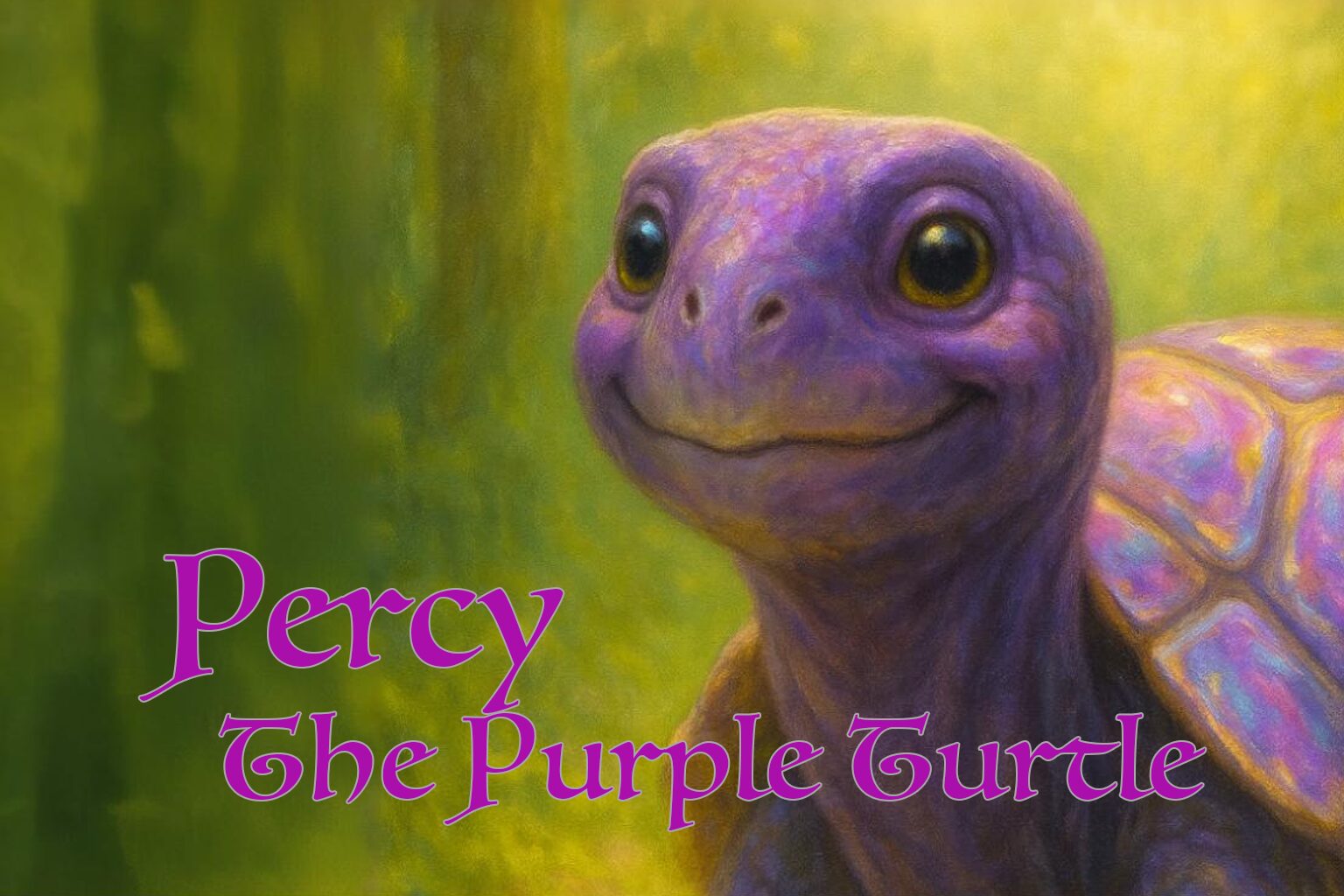
Percy was not like the other turtles. His shell wasn’t the usual green or brown — it was a brilliant, shimmering purple that sparkled softly in the sunlight. But instead of feeling proud, Percy felt different. And one day, when a cheeky fox laughed at his unusual color, Percy’s heart sank. From that moment on, he feared others might laugh at him too.

Though Percy had a strong shell to protect him, it was purple as well, so it didn’t feel like a safe hiding place. The colors that made him special also made him vulnerable.

To keep himself safe, Percy began to build. First, he made a simple fence around his little spot in the forest. But soon he worried some animals might still cross it, so he added barbed wire. Still, some animals could jump over that, so he built a tall, solid wall — without windows, so no one could peek inside. But birds could fly over the wall, so he added a roof to cover it all.

With no windows and a roof blocking the sky, no sunlight could enter. The air inside was thin and still. Percy’s home had become a fortress, but it felt more like a prison.

Animals in the forest often looked at Percy’s fortress, whispering but never saying anything — neither kind nor cruel. Percy felt alone.

One day, a gentle voice called from outside the wall, “Hi, are you alright in there?”

Startled and scared, Percy pulled deeper into his shell and said nothing.

The voice returned the next day, softer still. “I’m Lila. I just wanted to make sure you’re okay. You don’t have to answer if you don’t want to.”

Days passed. Each morning, Lila would simply say, “Good morning, Percy. I hope you’re well today.”

Finally, Percy’s curiosity overcame his fear. “How… how do you know my name?”

“The other animals told me,” Lila said gently. “They remember you from before you built your walls.”

Percy was quiet for a long moment. “They… they remember me?”

“Of course they do. Why wouldn’t they?”

“Because I’m… different. Strange. My shell is the wrong color.”

“Wrong according to whom?” Lila asked, genuinely curious.

Percy hesitated. He’d never been asked that before. “Well… according to… to everyone, I suppose.”

“Everyone? Really? Have you asked them all?”

The question hung in the air. Percy realized he had never actually asked anyone what they thought. He had simply assumed, based on one fox’s laughter a long time ago.

“I… no. I haven’t asked anyone.”

“That’s understandable,” Lila said kindly. “Sometimes we create stories in our minds to protect ourselves from potential hurt. But Percy, can I ask you something? Do you like every animal in the forest?”

Percy considered this carefully. “No… no, I don’t. Some I find loud and overwhelming. Others seem unkind. Some just… rub me the wrong way.”

“And does that make those animals bad or wrong?”

“No,” Percy said slowly. “They’re just… not for me, I suppose.”

“Exactly. So if you don’t connect with every animal, why do you expect every animal to connect with you?”

Percy sat with this thought for a long time. The silence stretched comfortably between them.

“I… I never thought of it that way,” he finally whispered.

“It’s like expecting every flower to be your favorite,” Lila continued gently. “Some people love roses, others prefer daisies. It doesn’t make any flower less beautiful or worthy.”

Percy felt something shift slightly inside him, like a door cracking open just a sliver.

“But what if the ones who don’t like me think there’s something wrong with me?” he asked, his voice small.

“Percy, let me ask you this: if someone told you that the sky should be green instead of blue, would you believe the sky was wrong?”

“No, that’s silly. The sky is blue. That’s just… how it is.”

“Exactly. And you are purple. That’s just how you are. Someone else’s opinion doesn’t change the truth of you.”

Percy felt tears forming in his eyes. “I built this to protect myself. But sometimes… sometimes it feels like a prison.”

“So you’re safe from pain,” Lila said softly, “but you’re also safe from joy. Safe from connection. Safe from love.”

Percy looked around his fortress – the walls that blocked out light, the roof that kept out sky, the space that felt smaller each day.

“I’m scared,” he whispered.

“Of course you are. Fear is natural when we’re considering stepping into the unknown. What specifically scares you most?”

“What if… what if I come out and I’m still alone? What if nothing changes?”

“And what if you stay in, Percy? What if nothing changes then?”

“Lila?”

“Yes?”

“Would you… would you stay nearby if I made a small opening? Just a small one?”

“I would be honored to,” she said warmly.

Very slowly, very carefully, Percy began to remove one stone from his wall. A thin beam of sunlight streamed in, and for the first time in years, he saw light dance across his purple shell.

It was still purple. It was still beautiful. And somehow, in that gentle light, it looked exactly as it should be.

“One stone at a time,” Lila said softly. “There’s no rush, Percy. We have all the time you need.”