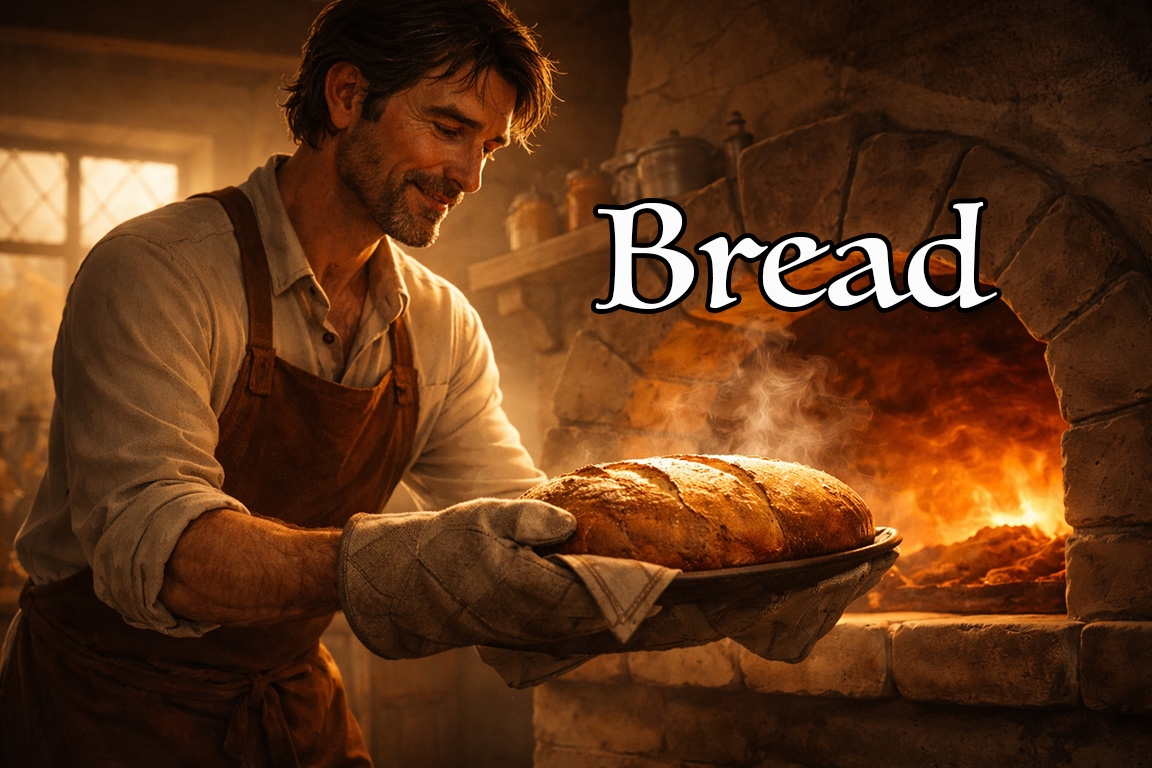
It is common for people in villages to wake up to the sound of roosters calling, but our story begins not in such village, not because it was an uncommon village but because in the village people woke up to the smell…
It was the most fantastic smell you can imagine—warm crust and roasted grain, yeast and butter, the sweet char of bread pulled fresh from the oven. And however well you think you can imagine it, there is no chance you can imagine how good it tasted unless you actually tasted it.
Everyone knew the baker. Everyone loved the baker. But more than that, they loved his bread.
Though it was no secret, very few outside the village ever got to taste it. By the time travelers arrived at the bakery, there was never any left to sell.
And so you might imagine the grief and sorrow that fell on the village when the baker, one quiet morning, passed away.
The ovens went cold. The streets smelled only of dust and cooking fires.
Like everyone in the village, John missed the bread. He missed waking to the smell. He missed sitting with his morning coffee, tearing off pieces of warm crust, the butter melting into the soft inside.
But John missed it more than most.
He found it hard to get out of bed. He couldn’t find the motivation. Life had lost its taste.
Every morning he walked past the silent bakery. “It’s such a shame,” he would say to no one in particular. “No one can ever make bread like he did.”
At home he spoke of it often. How the crust used to crackle. How the inside was soft as a pillow. How the baker’s hands seemed to know secrets no one else knew.
His wife listened for many days before she said, gently, “You could learn to bake.”
He waved his hand. “That’s too much work. It would take too long. I wouldn’t know where to begin.”
So he continued to complain. And the ovens continued to gather dust.
One evening, tired of hearing about bread but never smelling it, his wife placed a bowl on the table. She poured flour into it. Then a little water.
“Just mix it,” she said.
He sighed loudly, but he mixed.
The next day she placed the bowl in front of him again. “Just knead it,” she said.
Grumbling, he kneaded. The dough resisted at first, then began to yield. There was something oddly satisfying in the rhythm of it—the push, the fold, the turn. He found himself settling into the strange, repetitive motion almost without noticing.
On the third day she said, “Just light the oven.”
By the fourth day there was dough on the table.
By the fifth day there was something that almost looked like bread.
It was dense. Burnt on one side. Pale on the other. When he pulled it from the oven, it sat on the counter like an accusation.
“This is pointless,” he said, pushing it away. “It’s nothing like his bread.”
His wife broke off a corner. Chewed. Swallowed.
“A week ago,” she said quietly, “you told me you didn’t even know where to start. And now you’ve made bread. Isn’t it worth one more try to get closer to what you want?”
He stared at her. Then at the sad, lopsided loaf.
The next morning he stood in the kitchen, looking at the bowl, the flour, the quiet oven. He almost walked away.
Then, mostly out of stubbornness, he mixed.
A week later he rose before his wife.
Two weeks later he adjusted the oven temperature without being told.
A month later, the neighbors began to notice a scent drifting through the street again.
And one morning, as John pulled a golden loaf from the oven—crisp-crusted, properly risen, still imperfect but undeniably bread—he realized something quietly surprising.
He had not waited to feel like baking.
He had baked… until he felt like baking.