
The Illuminated Path
A story about failures
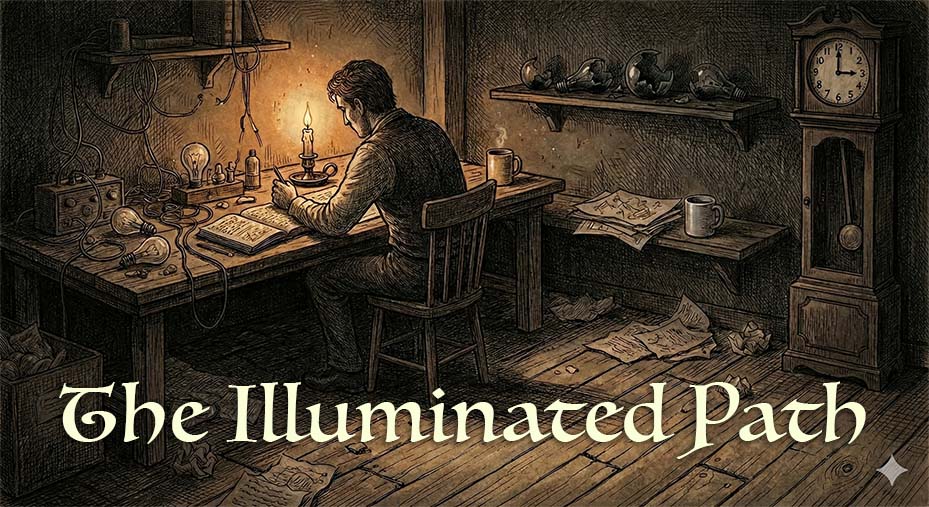
The boy stood in the darkness of his family’s cellar, watching a single candle flicker against the wooden beams. He was supposed to be helping his mother preserve vegetables, but instead he stood transfixed, wondering why light had to come with smoke and heat and the constant threat of fire. There had to be another way.
Twenty years later, that boy had become a man with calloused hands and tired eyes, standing in a laboratory that smelled of burnt copper and desperation. His clothes were rumpled from another night spent sleeping on the workbench. Around him, tables overflowed with wire, glass, and the shattered remnants of dreams.
He had spent everything on this obsession. The inheritance from his father—gone. The money from his previous inventions—reinvested and consumed. His wife had learned to mend the same three dresses, to cook meals that stretched further than seemed possible. His children knew their father as the man who disappeared into the workshop before dawn and emerged after dark, if he emerged at all.
The investors were losing patience. Their letters grew shorter, colder. Some stopped writing altogether.
He would wake at night, heart pounding, replaying the same questions: What if they were right? What if he was chasing something impossible? What if he was a fool squandering everything his family had on a dream that would never materialize?
The worst moments came in the silence after another ill attempt. The smell of burnt materials lingering in the air. The sound of glass cracking as it cooled. The weight of knowing he’d have to face his wife again, tell her they needed to stretch their money just a little further, ask for just a little more time, more patience, more faith in something he himself was beginning to doubt.
Some mornings, he couldn’t bring himself to enter the laboratory. He would stand outside the door, hand on the handle, paralyzed by the certainty that today would bring nothing but more of the same. More attempts. More careful documentation of failure. More proof that perhaps everyone else was right and he was wrong.
The problem was the filament. Everything he tried burned too quickly or shone too dimly or cost too much to produce. Carbonized paper—burned out in minutes. Platinum wire—impossibly expensive. Carbonized bamboo from Japan—promising, but still not right.
His assistants quit, one by one. They found steadier work, more reasonable employers. He didn’t blame them. Who wanted to be part of an endless parade of failures?
One evening, his eldest daughter found him staring at a workbench covered in blackened glass bulbs, each one a monument to what hadn’t worked.
“Papa,” she said quietly, “why do you keep trying?”
He picked up one of the failed bulbs, turning it in his hands. The carbonized thread inside had lasted fourteen seconds before burning out.
“Because every time something doesn’t work,” he said, “I learn exactly why it doesn’t work. And that’s not nothing, my dear. That’s everything.”
She didn’t understand, and he couldn’t blame her for that either.
The newspaper reporters began writing cruel columns about “the inventor who plays with fire and calls it progress.” Cartoonists drew him as a mad scientist, surrounded by explosions and dollar bills going up in smoke. Former friends crossed the street to avoid conversation.
His wife found him one night, slumped over his workbench at three in the morning.
“How many times?” she asked. “How many times have you tried?”
He consulted his laboratory notebooks, pages dense with sketches and observations and measurements. Each failed attempt meticulously documented.
“Nine hundred and ninety-nine different filament materials,” he said. “Nine hundred and ninety-nine ways that don’t work.”
She was quiet for a long moment. Then she touched his shoulder gently.
“Maybe that’s enough,” she said. “Maybe it’s time to—”
“One more,” he interrupted. “Just one more.”
She sighed, but she didn’t argue. She had married a dreamer, after all.
The thousandth attempt used a carbonized cotton thread, treated in a way his previous experiments had suggested might work. He sealed it in the glass bulb, evacuated the air, connected the wires.
When he threw the switch, light bloomed—steady and warm and impossibly beautiful.
It burned for fourteen hours.
Then forty.
Then a hundred.
Six months later, he stood before a room full of reporters, investors, and skeptics. The demonstration bulb glowed above his head, steady and bright, no smoke, no flame, just pure electric light.
“Mr. Edison,” a reporter called out, pencil poised above his notebook. “We’ve heard it took you thousands of attempts to perfect this invention. How did you find the strength to endure so many failures?”
The room fell silent, waiting for his response.
Edison looked up at the glowing bulb, then back at the audience. A small smile played at the corners of his mouth.
“Failures?” he said. “I never failed once. I simply discovered nine hundred and ninety-nine ways not to make a light bulb.”
He paused, letting the words settle over the crowd.
“Each attempt taught me something essential. Each ‘failure’ eliminated a false path and brought me closer to the truth. The only real failure would have been stopping before I found what worked.”
The reporters scribbled furiously. The investors leaned forward, suddenly understanding why they’d bet on this particular madman.
And the light above them continued to burn, proving that sometimes the longest path through darkness is the only way to truly understand illumination.
Edison touched the switch, and the room plunged into darkness. Then, with a flick of his finger, light returned—as simple and miraculous as flipping a switch.
“Gentlemen,” he said, “the future is bright. And it took every single one of those nine hundred and ninety-nine lessons to make it so.”
Here are more stories for you to enjoy: